







Do you know the feeling? You've spent hours working on your knitting, you cast off, and the edge is so tight that you can barely get it on. For socks, hats and ribbing in particular, a stretchy cast-off is essential. In this guide we show you four tried-and-tested methods for casting off elastically, so that your next project gets the perfect finish.
Why cast off elastically?
A standard cast-off creates a firm edge that barely stretches. On garments that are pulled over the head, hands or feet, this causes problems: sock cuffs dig in, hat edges sit too tightly, and shawls can't be blocked properly. An elastic cast-off solves all of these problems, as the edge stays stretchy and still looks neat.
Method 1: Twisted cast-off
The simplest method, and particularly suitable for beginners.
Here's how:
- Knit the first two stitches.
- Slip both stitches back onto the left needle.
- Knit both stitches together through the back loops (insert the needle from behind).
- Knit the next stitch, so that you have two stitches on the right needle again.
- Repeat from step 2 until all stitches are cast off.
Ideal for: ribbing on jumpers, wrist warmers and scarves. This method gives an even, nicely stretchy edge.
Method 2: Cast-off with a yarn over (Jeny's method)
The stretchiest of all the methods, perfect for toe-up socks and shawls.
Here's how:
- Make a reverse yarn over on the right needle (thread over the needle from back to front).
- Knit one stitch.
- Pull the yarn over across the knitted stitch.
- Make another reverse yarn over on the right needle.
- Knit the next stitch.
- Pull the yarn over and the previous stitch over the stitch you have just knitted.
- Repeat from step 4.
Ideal for: socks (toe-up), shawls and anywhere maximum stretch is needed.
Method 3: Icelandic cast-off
Particularly suitable for projects knitted in garter stitch, such as shawls and scarves.
Here's how:
- Knit one stitch.
- Slip the stitch from the right needle back onto the left needle.
- Insert the right needle as if to purl and knit the next stitch, pulling the loop through both stitches.
- Repeat from step 2 until all stitches are cast off.
Ideal for: shawls, scarves and blankets knitted in garter stitch.
Method 4: Sewn cast-off (after Elizabeth Zimmerman)
This technique creates a particularly neat, elastic edge, but it is worked with a darning needle instead of knitting needles.
Here's how:
- Cut the working thread, about 3–4 times as long as the edge to be cast off.
- Thread the yarn onto a darning needle.
- Pass the needle through the first two stitches as if to purl (from right to left).
- Go back and pass the needle through the first stitch as if to knit (from left to right). Let this stitch slip off the knitting needle.
- Repeat from step 3 until all stitches are cast off.
Ideal for: ribbing on socks and hats, when a particularly professional finish is wanted.
Which method for which project?
| Project | Recommended method |
|---|---|
| Sock cuffs | Jeny's method or sewn cast-off |
| Hat brim | Twisted cast-off |
| Shawls & scarves | Icelandic cast-off or Jeny's method |
| Jumper ribbing | Twisted cast-off |
| Wrist warmers | Twisted cast-off |
Tips for a perfect result
- Work loosely: It's better to cast off slightly too loosely than too tightly. You can always pull it tighter, but you can't make it looser.
- Use a larger needle: If your edge still turns out too tight, switch to a needle that is 1–2 sizes larger for the cast-off.
- Allow enough thread: For the sewn cast-off you need a thread 3–4 times the length of the edge being cast off.
- Gauge: Try out your chosen method on a test piece before you cast off your project.
The right yarn makes all the difference
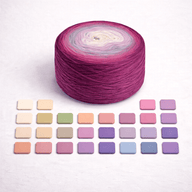
An elastic yarn adds to the stretch of your cast-off edge. For socks we recommend our sock yarn, which was developed especially for hard-wearing, elastic projects. Our gradient yarn is particularly well suited to shawls and scarves, as the colour gradients look beautiful in shawls.
Are you looking for the right yarn and detailed instructions for your next project? In our knitting kits you'll find everything you need: yarn and pattern in one package.
Discover more patterns
Browse our other free patterns and techniques:
